Quotes

Final Results of NCSU Stormwater Treatment Performance Monitoring

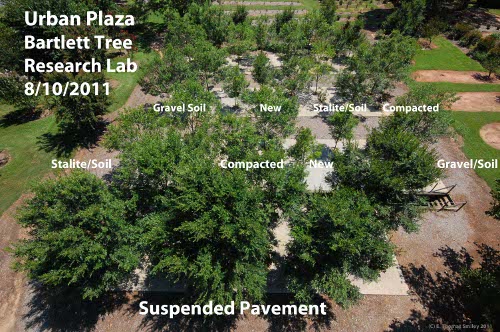
How do the stormwater benefits of Silva Cell suspended pavement tree/soil systems compare to the stormwater benefits of traditional bioretention systems? Since the mechanisms by which the tree and soil provide the stormwater benefits in these systems are the same as those in traditional bioretention, we expected the benefits to be comparable as well. The… More

Read Article

What Factors Determine Root Growth in Rock-Based Soils?

There is a lot of misinformation in the landscape architecture community about whether or not trees roots will grow in gravels, structural stone soils, and clear stone. Our experience indicates that roots will adventitiously grow in any medium given the right set of circumstances. Quantifying and predicting what set of circumstances produce that growth response… More

Read Article

Touch the Soil: Healthy Soils for Healthy Trees

For the last two weeks in December I’m re-posting some of my favorite blog posts from this year. Today’s, by James Urban, perfectly captures what we need to do in order to create healthier urban environments for trees and soils. It’s simple. Touch trees. – LM Alex Shigo, one of the most famous plant biologists and… More

Read Article

The Most Important Factor for Growing Healthy Trees

Many factors affect tree health. Are they all equally important or are some more important than others? According to Kim Coder, soil compaction is by far the biggest constraint on tree growth. In a 2007 paper, he wrote, “Soil compaction is the most prevalent of all soil constraints on shade and street tree growth…Many people… More

Read Article

Soils Guy: An Interview With Tim O’ Hare

Tim O’Hare Associates LLP is a leading independent environmental consultancy based in the United Kingdom specializing in soil science and landscape engineering, including soil science, topsoil, habitat creation, sales pitch agronomy, and more. A few weeks ago I talked to Tim O’Hare himself to learn more about its reuse, recovery, and what it really means… More

Read Article

An Open Letter to the Complete Streets Movement

A large-canopy tree is a very beautiful thing. On this, most people will agree. But is not only beautiful—it also benefits its community. It provides shade and shelter, protects air quality, and reduces air temperatures, water runoff, and human stress. A street lined with such trees is a desirable place to live and work, and… More

Read Article

Illustrated Guide To Using Trees and Soils to Manage Stormwater

I’ve discussed using trees and soils (green infrastructure) to manage stormwater in two recent webinars. This is a rich and complex topic, so to help break it down into digestible pieces I organize it in to what I call the First Principles of Urban Stormwater Systems. Those first principles are listed in the illustration above…. More

Read Article

The Effect of Trees in Paving on Stormwater Runoff

A study recently published in Urban Forestry & Urban Greening presents data showing that trees planted in paving can significantly reduce stormwater runoff. The results, published by D. Armson, P. Stringer, and A.R. Ennos, are taken from data collected in Manchester, UK from January 2011 to September 2011. The study created 5 test sites, each containing three 9… More

Read Article

New Zealand’s Ultra-Comprehensive Report on Bioretention Media

I spent a good part of last winter completing a  literature review on bioretention media for a revision to the Minnesota Stormwater Manual. So when I attended the Low Impact Development (LID) conference in St. Paul, MN earlier this month, I was very interested to learn of a recent specification coming out of New Zealand:… More

Read Article

Tigard, OR Sets Soil Volume Minimum for Street Trees

We recently learned that Tigard, OR, a town of about 48,000 people that is part of the Portland metro area, has implemented an impressive soil volume minimum for trees planted in streets and parking lots: up to 1,000 cubic feet of soil per tree.

Read Article

LEED V4: How does it affect trees, soils, and stormwater?

LEED version 4 (V4) is the fourth and latest iteration from LEED (Leadership Environment, Energy & Design), a rating system developed by the U.S. Green Building Council and independently certified by the Green Building Certification Institute. The primary mission of LEED is to encourage the marketplace to provide sustainable buildings, sites, and neighborhood development using… More

Read Article

Join Our Newsletter

Sign up to our newsletter to stay up-to-date on news, updates, and product information.

Explore our archives

Interested in a DeepRoot product? Get a quote today.

Request a Quote [email protected]

Tel: 415 781 9700
Toll Free: 800 458 7668
Toll Free: 800 277 7668
Fax: 415 781 0191


Sign up to our newsletter to stay up-to-date on news, updates, and product information.