

Introduction
Why are streetlights and sidewalks considered municipal assets — but not trees?
Most cities manage detailed inventories of their physical infrastructure: light poles, sewer lines, benches, trash bins, snowplows. These things are logged, valued, maintained — and budgeted for. They’re viewed not just as integral components of the public realm, but as long-term investments that require careful attention to perform as intended.
But what about street trees?
Despite their obvious presence and growing importance in urban life, trees are still too often treated as extras — aesthetic enhancements rather than essential public infrastructure. As a result, they rarely receive the early planning or long-term care that defines true asset management.
And that’s a problem. Because unlike a light pole, a tree’s value grows over time. But urban trees only deliver their full community benefit — shade, stormwater management, cooling, air quality — when they reach maturity. That return on investment only materializes if they’re supported properly from the start.
It’s time to start thinking differently about urban trees, viewing them as the important municipal asset they are and providing the conditions they need to thrive.
Outdated Thinking: Trees Aren’t Just Aesthetic Niceties
For decades, trees have been treated as visual enhancements to city design. They frame streetscapes, soften architectural edges, and bring a welcome sense of nature into built environments. But too often, that’s where their perceived value ends — and this mindset leads to problematic underinvestment. What are some of the pitfalls of this thinking?
- DESIGN ADD-ONS: Rather than being part of the vision from the outset, city trees are often viewed as an afterthought: a final addition after utilities, paving, drainage, etc., as opposed to being an important design feature throughout.
- MISALLOCATED BUDGETS: When the lifespan value of trees is misunderstood, the budget to support this long-term asset is often underfunded or nonexistent.
- FOCUS ON PLANTING, NOT GROWTH: As Jim Urban always said, it’s better to put a $5 tree in a $50 hole than a $50 tree in a $5 hole. Investment in proper growth conditions, like uncompacted soil, is a critical and often overlooked component of tree planting.
In other words, trees are still seen as “nice to have,” not “need to have.” But in a warming world with rising stormwater challenges, equity gaps, and health disparities, that view is not just outdated — it’s irresponsible.
Trees as Assets: A Simple Case
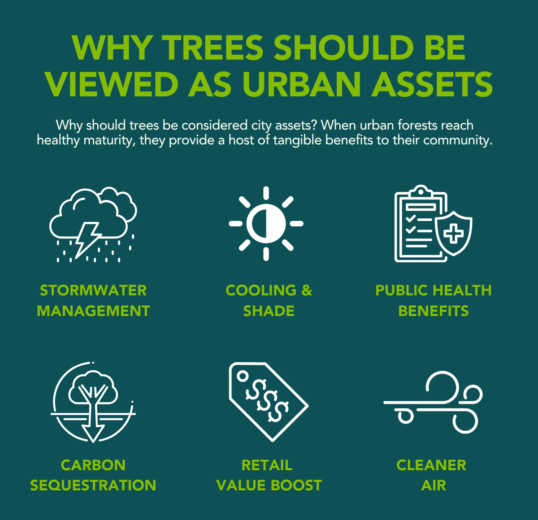
Urban trees are living infrastructure. They do measurable work — and they do it well. A single healthy street tree can provide:
- STORMWATER MANAGEMENT: Reduced runoff volume and burden on gray infrastructure.
- SHADE AND COOLING: Lowered surface and air temperatures by as much as 30 degrees.
- ENERGY SAVINGS: Reduced demand for air conditioning in adjacent buildings.
- IMPROVED AIR QUALITY: Filtered particulate matter and pollutants.
- CARBON CAPTURE: Absorbed and stored atmospheric CO₂.
- HEALTH BENEFITS: Stress reduction, mental health boosts, and increased physical activity.
- INCREASED COMMERCE: From boosted retail sales to higher adjacent property values
It’s really very simple. Trees deliver a host of advantages — and not just fringe benefits. They’re core functions that improve quality of life, reduce public costs, and enhance urban resilience. And they’re only delivered at scale when trees reach maturity, which takes decades. Trees, quite simply, are assets with a delayed but compounding return on investment.
Think Differently: A Vision for the Future
If cities want trees to deliver real value — cooling streets, managing stormwater, improving health, and boosting local economies — they need to stop treating them like decorative afterthoughts. Trees are living infrastructure, and like any other asset, their benefits only materialize when cities plan, fund, and maintain them properly.
This requires a shift in how trees are integrated into city planning and budgeting. Just like streetlights or water pipes, trees should be inventoried, valued, and tracked. They should have dedicated budgets for both installation and long-term care — because planting without follow-up is simply wasted investment. Cities also need to recognize the ROI of urban trees, which can be measured in reduced energy costs, improved public health, and enhanced property values.
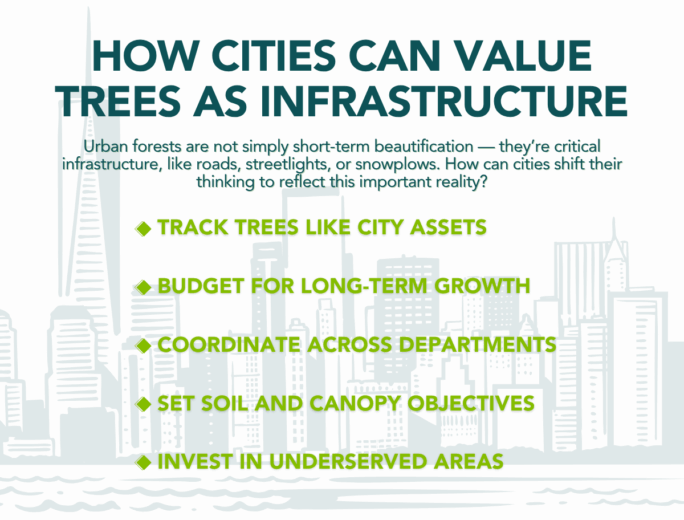
To make this vision real, we need practical steps:
- Include trees in municipal asset inventories, with data on health, age, and location.
- Set tree canopy targets and soil volume standards.
- Allocate annual maintenance funding for watering, pruning, and soil care.
- Coordinate across departments (public works, planning, utilities) to protect and prioritize trees.
- Place trees strategically, especially in underserved areas where they can address heat and stormwater challenges.
- Wring the most functionality out of these assets by taking advantage of their multidisciplinary benefits, including stormwater treatment.
A new way of thinking about trees isn’t just about adding greenery — it’s about leveraging a powerful, living system that can pay dividends for decades if managed well.
How Silva Cells Fit This Strategy
Urban trees can’t grow into high-performing assets without the right conditions — especially underground. Their roots need access to uncompacted soil, even when planted beneath streets, sidewalks, and plazas. Silva Cells have been helping trees thrive in these challenging conditions for nearly two decades. As a supportive infrastructure system, Silva Cells provide large volumes of soil beneath hardscape (while protecting these hardscapes from buckling) while also enabling on-site stormwater management through bioretention.
While this blog is focused on advocacy and policy change, we believe Silva Cells represent one of the best strategies for ensuring that newly planted trees aren’t just installed — but set up to succeed. Because when you invest in supportive infrastructure at the start, you increase the likelihood that a tree will survive, thrive, and deliver its full return over time.
Conclusion: Adding Trees to the Ledger
We’re facing urgent urban challenges: rising heat, aging gray infrastructure, unequal access to green space, and more frequent flooding. Urban trees are one of the most versatile, cost-effective, and publicly loved tools we have to address them.
But only if we treat them that way.
Cities must begin viewing trees as core infrastructure — not peripheral decoration. That means tracking them, budgeting for them, protecting them, and planning for their long-term success. Like any other asset, trees require early investment and ongoing care.
It’s time to stop treating trees like decoration — and start treating them like what they are: public infrastructure with a living return on investment.

As a responsible tree service company owner, I al always trying to educate people on tree maintenance and have refered home owners to an arborist for treatment, we need to replant more trees and have healthier enviroments.
http://www.willowtreeremoval.com