

Introduction
Underground stormwater storage systems don’t always play nicely with trees. They’re typically designed as siloed subsurface systems — isolated from surrounding soil and root zones to reduce risk and simplify performance. Trees, on the other hand, require space, soil volume, and access to water to grow and thrive.
The result is a disconnect. Stormwater systems are placed away from planting areas, while trees are confined to limited soil zones that restrict their long-term health. These two systems, both essential to resilient urban environments, are rarely designed to work together in the same space.
Marino Cell was engineered with a different approach. Instead of avoiding trees, it integrates alongside them, due to both its exceptional loading strength and DeepRoot’s industry expertise in tree root guidance.
The Disconnect: Stormwater Storage and Trees
There are two primary reasons why stormwater storage systems and trees have historically been kept apart.
First, trees require soil — and soil is heavy. Soil zones, root balls, and saturated planting environments create significant dead loads that many traditional storage systems are not designed to support. These systems are often optimized for lightweight conditions and shallow cover, making them incompatible with planted landscapes above.
Second, tree roots naturally seek out water and oxygen. In conventional storage systems, this creates an obvious risk: roots can infiltrate storage voids, disrupt system performance, or damage infrastructure. To avoid this, designers often default to separation: they keep trees at a distance rather than addressing the interaction directly.
This risk-avoidance approach limits what projects can achieve. In tight urban footprints, it forces design teams into difficult tradeoffs, where stormwater management and tree planting become an either/or proposition. True ecological function, where systems work together, is difficult to realize under these constraints. Marino Cell helps solve this puzzle.

Traditional stormwater storage tanks don’t integrate well with trees, forcing tradeoffs and ultimately the sacrificing of surface green space.
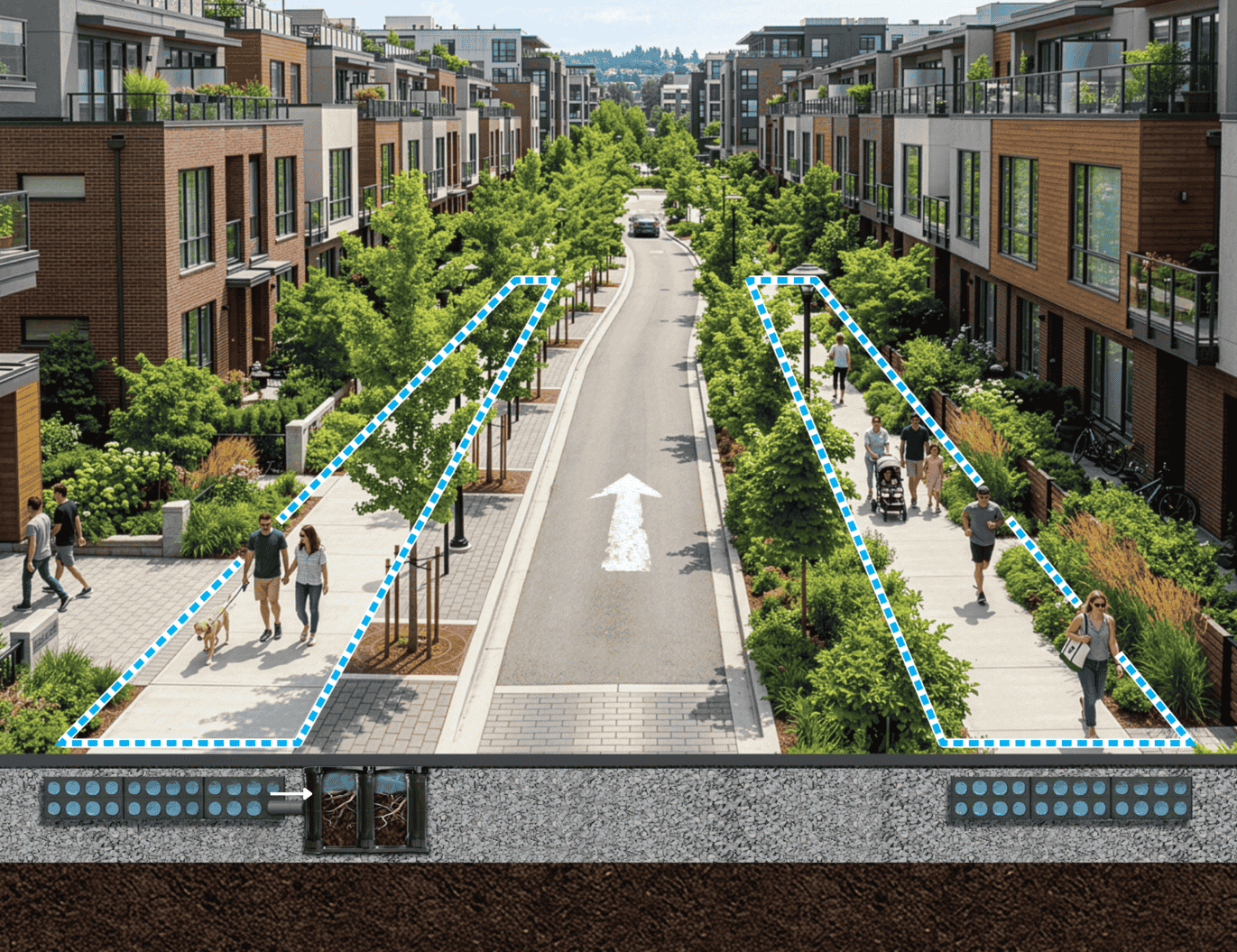
Marino Cell can be installed in tree-lined areas, allowing for stormwater storage and green space in the same neighborhood (as well as the ability to work alongside Silva Cell for ultimate green ecological function).
Marino Cell Plays Nice with Trees
The Marino Cell design approach is not about avoiding the risk of adjacent trees, but about designing a stormwater storage system that can integrate alongside them.
This means addressing the very challenges that have historically kept these systems apart (structural loading, root interaction, and spatial conflict) and reducing risk and liability. By doing so, Marino Cell allows stormwater infrastructure and trees to coexist, and even support one another, within the same footprint.
Strength Capacity
One of the biggest barriers to integrating trees with subsurface stormwater storage is weight. Trees require substantial soil volumes to support healthy root systems, and that soil becomes significantly heavier when saturated. Root balls, planting media, and long-term landscape loads create continuous pressure that many traditional systems are not designed to handle.
Marino Cell is built to support these conditions. Its structural design allows it to perform under the dead loads associated with planted environments, enabling placement near or adjacent to tree rooting zones without compromising system integrity. This eliminates the need to separate stormwater storage from trees simply due to weight limitations.
The result is a system that supports real landscapes, allowing designers to bring stormwater and tree systems closer together.
Root Guidance Expertise
For many storage systems, roots are treated as a threat. Because roots naturally grow toward water, underground stormwater systems can become unintended targets, raising concerns about clogging, displacement, or long-term damage.
At DeepRoot, this challenge is not new. In fact, it’s our area of expertise. For decades, we have developed solutions specifically designed to guide root growth and protect infrastructure. Through root barrier systems and soil management strategies, we understand how to direct roots where they should grow — and just as importantly, where they should not.
This knowledge changes the equation. Instead of avoiding trees, Marino Cell can be deployed with confidence alongside them, supported by proven root guidance strategies. The system doesn’t just tolerate roots; it works within a framework that manages them.
Silva Cell Synergy
Marino Cell’s ability to integrate with trees is further strengthened by its relationship with Silva Cell. Together, these systems represent a comprehensive approach to designing underground environments that support both stormwater management and long-term tree health.
Silva Cell provides uncompacted soil volume for root growth, while Marino Cell manages and stores stormwater nearby. This combination allows water to be slowed, stored, and reused within the same system that supports tree development.
By aligning soil and stormwater strategies, designers can maximize the ecological performance of underground space, supporting tree growth, improving water quality, and reducing peak flow, all within a unified approach.
Rethinking Trees and Stormwater
In natural systems, trees and water are inseparable. Rain falls, soil absorbs it, and trees use it to grow. Urban environments don’t have to break that relationship; they simply need better tools to support it.
Marino Cell offers a new way forward. By removing the traditional barriers between stormwater storage and trees, it allows projects to move beyond compromise and toward integration.
Whatever your vision for a truly functional, resilient landscape, it shouldn’t require choosing between green strategies. With the right approach, stormwater and trees can work together and support healthier environments, stronger performance, and more efficient use of space.
Marino Cell makes that possible.




Leave Your Comment