

Introduction
Silva Cells were the first commercial soil cell product on the market, but did you know the idea of suspended pavement systems date back many years to urban European streetscapes? From Paris and London to Boston and Redwood City, let’s take a brief tour through the use and evolution of suspended pavement systems throughout the world.
Boston, Redwood City, and Silva Cells
Site analysis is a crucial step in any landscape design. By incorporating site history and context you can create more meaningful design with increased potential that fits better into the culture, use, and longevity of the place. I have been in many presentations where the first thing they do is to show historical documents, maps, ancient tributary routes, and old planting details. The land we live on is grounded in history. Evaluating old examples of what we do is quite illuminating.
For example, we believe the earliest suspended pavement installation in the United States is the Christian Science Center in Boston (1968). We’ve written about it before. This site is a custom-poured concrete system of columns and beams for tree soil which is installed over a parking garage. It is effectively an intensive green roof, filtering stormwater and allowing the trees to get big. What is unique about this brutalist landscape is that Hideo Sasaki and IM Pei never bothered to permit the project for stormwater because it predates the Clean Water Act!
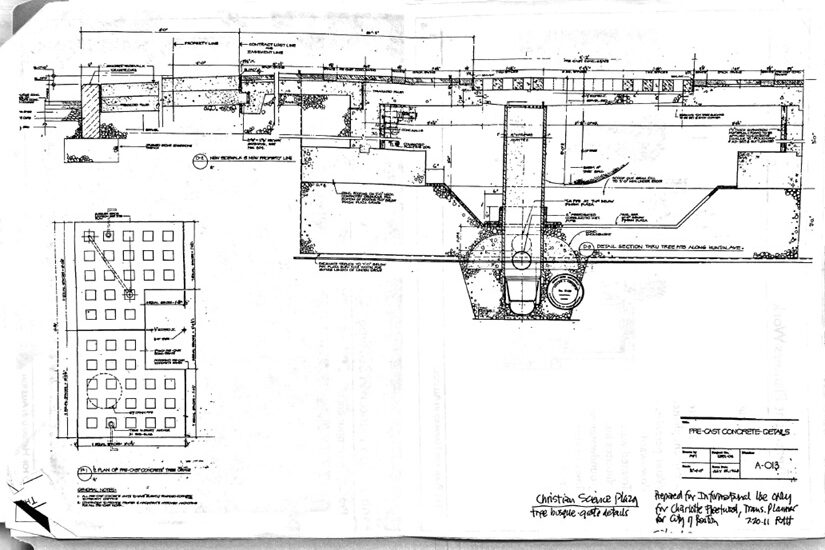
Christian Science Center details (1968)
Also, the first installation of load-bearing modules (i.e. Silva Cells) was at my sister-in-law’s house in Redwood City, CA, in 2007. She got a new driveway and 2 new trees in front. Jim Urban, Gordon Mann, Peter McDonough, Graham Ray, Steve Chatwin-Grindey, Mike James and other DeepRooters were all at the installation. Read about this site here and here. In fact, the one in porous paving is doing better than the one in non-porous paving. More importantly, however, the driveway is straight and even.
It’s a small project, but when inventing a whole new product category you have to walk before you run.
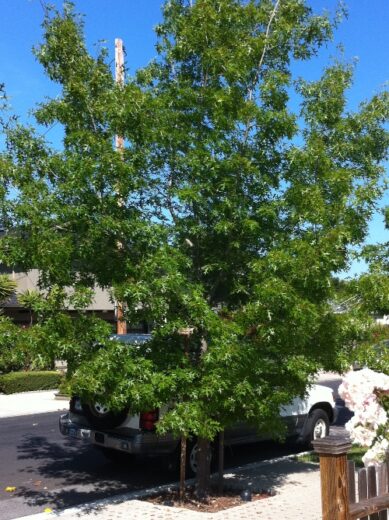
Tree planted in Silva Cell in Redwood City
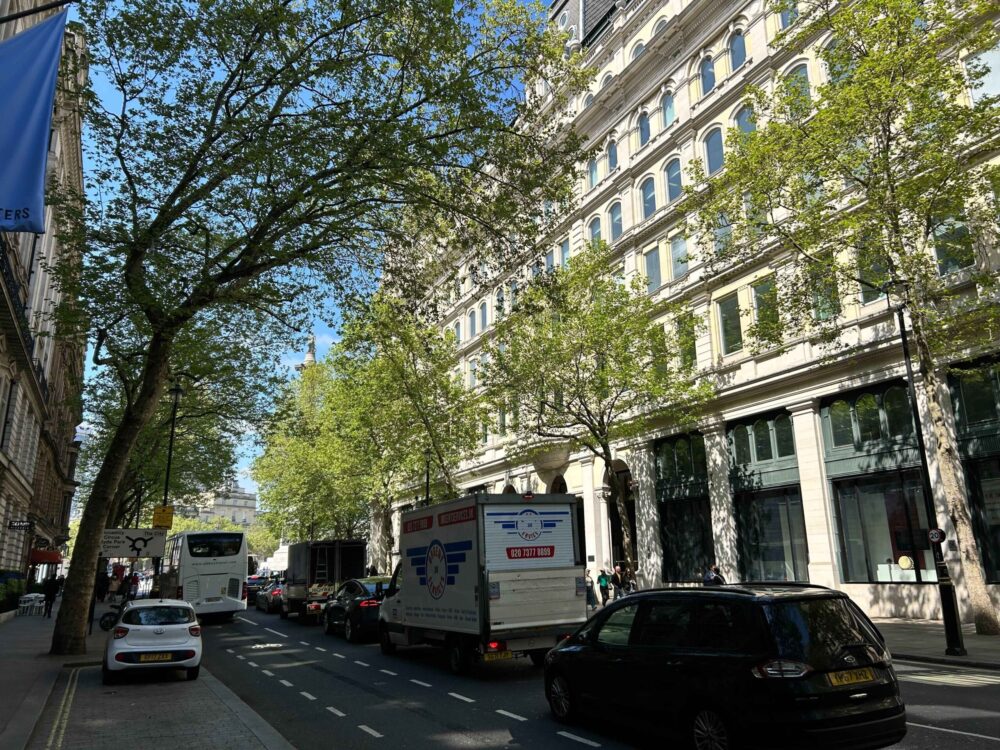
Northumberland Avenue, London
I finally realized that both of these sites are youthful by comparison to sites discussed in the book Street Trees in Britain – a History by Mark Johnston, PhD from the University of Ulster. To me, the most interesting pages are the ones which discuss the development of Northumberland Avenue in London. The street is only a few blocks long but goes from the Embankment straight to Trafalgar Square. This is the oldest known suspended pavement in the world. For any tree nerd traveling to the city, it’s a must-see street. Developed in 1898, it consists of a grade beam at the back of curb and another over by the building faces bridged by steel with a soft planting soil underneath. This treatment goes on for several blocks, the entirety of the stretch of the avenue. The pavement is straight and it’s beautiful.

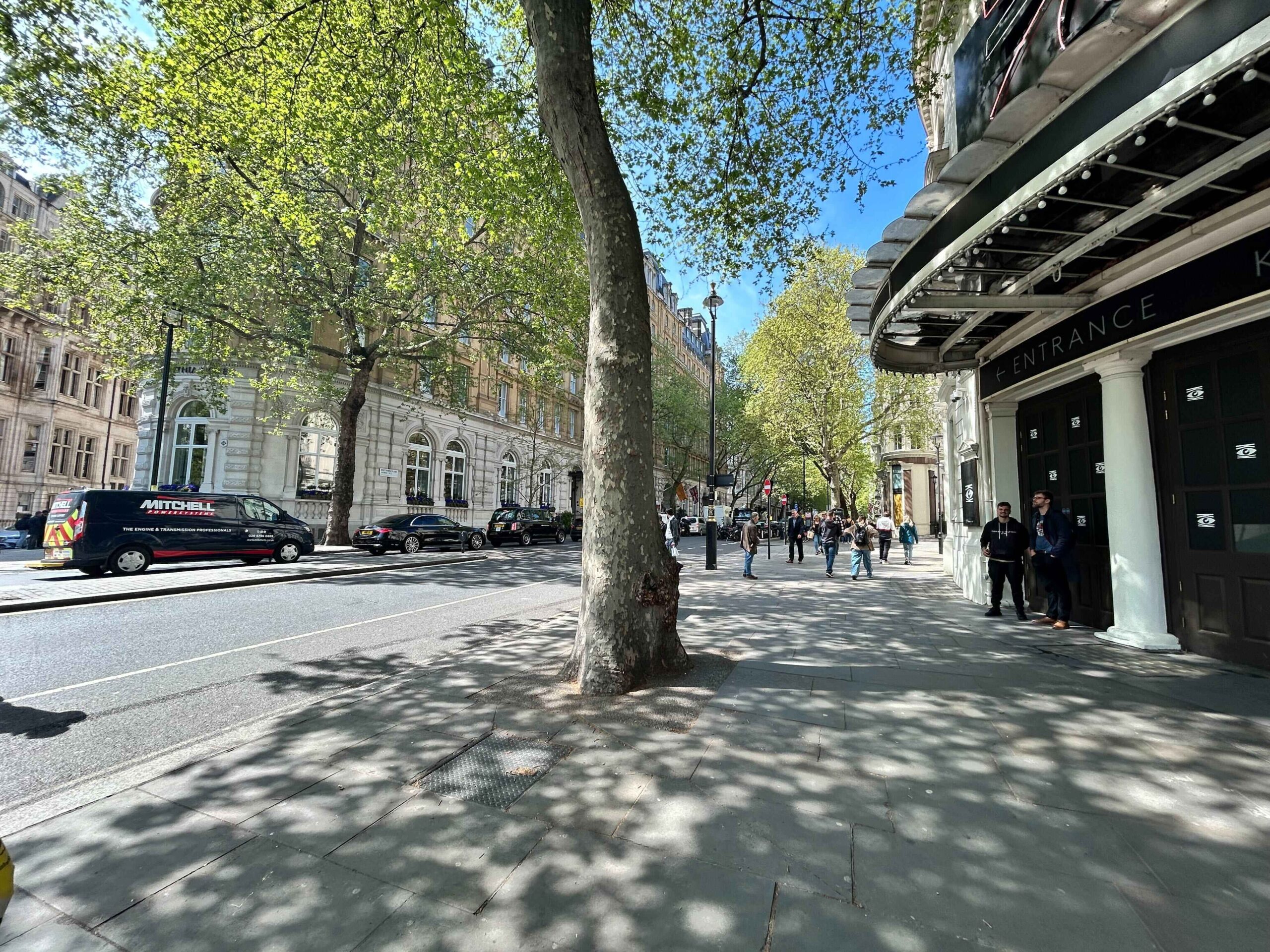
In terms of ecosystem benefit, the London Planes form the living green backbone of carbon sequestration, stormwater interception, urban cooling in a congested downtown urban space, along with multiple other societal benefits – and for over 125 years.
Johnston, citing the work of P.J. Edwards, A History of London Street improvements 1855-1897, says:
To secure the well being on the trees, pits were formed and filled with proper soil, and a foot way surrounding the trees was covered with an open grating to admit the rain and air to the soil and to enable it to be stirred and kept loose on the surface. The grating and footway were supported independently by girders over the tree pits so as to prevent the settlement of the paving and the hardening of the ground around the roots of the trees the plain trees were selected as most suitable for the atmosphere and the metropolis.
Tantalizingly, Johnston also sites an earlier work by JC Loudon in Gardeners Magazine entitled “Trees in public walks and boulevards in Flanders” 1827:
The modes of lessening the super incumbent pressure of the soil under the foot way are three: First, by vaulting; filling the vaults with the proper soil, preserving vertical and lateral communications for the introduction of water from the gutter between the pathway and the roadway, and forming a footpath of gravel, or other suitable material, over the vaults. Secondly, by building up piers from the bottom of the stratum of prepared soil to the surface, and on these piers resting flagstones to form the footpath; provision for the entrance if water being made as before.” And thirdly I’m mixing prepared soil with wood chips and manure as amendments.
We don’t know, and Johnston does not cite where these locations are, but apparently the technique to create suspended payments was quite common in Paris and in Belgium early in the 19th century; so, comparatively speaking, the Northumberland project was relatively late.
So, we always thought we invented this new product category, but it turns out we were just standing on the shoulders of others.




Leave Your Comment