

One of the most common questions posed when beginning an urban forest project is: how wide do tree roots grow?
The answer is almost always: wider than you think. Tree roots frequently extend well beyond the edge of the canopy, which means the visible dripline is only a starting point — not the boundary of the root system.
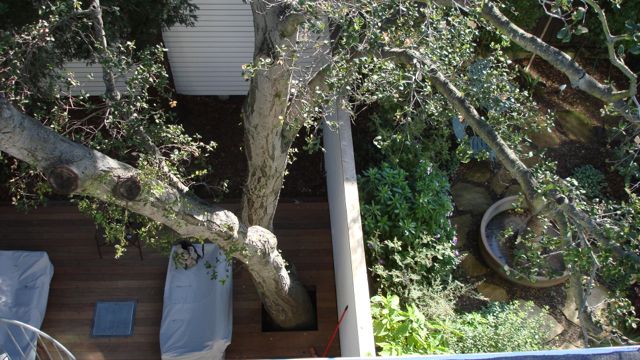
The roots of this oak tree (left) are certain to be found in the neighboring property (right)
Of course, that does not mean every tree follows the same pattern. Root spread is shaped by species, age, soil conditions, water availability, compaction, drainage, oxygen, nearby infrastructure, and the amount of usable soil available. In favorable, open landscapes, roots may spread far beyond the canopy. In cities, however, that same root system may be redirected or restricted by pavement, compacted subgrade, utilities, curbs, foundations, and limited soil volume.
So, rather than asking for one universal number, it is more useful to think in terms of practical planning guidance.
| Common Question | Answer |
|---|---|
| Do tree roots stop at the dripline? | No. The dripline is only a visual reference point. Many tree roots extend well beyond the edge of the canopy. |
| How far beyond the canopy can roots spread? | In quality, abundant soil, mature tree roots may spread two to five times the width of the canopy. |
| Is canopy width the best way to estimate root spread? | Not always. Canopy width is useful visually, but trunk diameter may be a better predictor, especially for young urban trees. |
| What is the relationship between trunk diameter and root spread? | Some research on young, unobstructed trees has found root radius increasing at roughly 38 times trunk diameter. This is not a fixed rule for every tree, but it helps show how wide roots can spread before the canopy looks especially large. |
| What should cities focus on when creating tree rooting space? | Soil volume. Creating quality, connected space for roots to spread supports opportunistic root growth and healthier aboveground trees. |
Source note: Colorado State University Extension notes that mature tree root systems may spread two to five times the width of the canopy; Iowa State University Extension describes root systems occupying four to seven times the surface area of the crown; and research by Susan Day and Eric Wiseman at Virginia Tech found root-system radius in young, unobstructed trees scaling at roughly 38:1 with trunk diameter. These sources all reinforce the same practical point: tree roots commonly extend beyond the dripline, but their actual spread is shaped by site conditions.
The problem is that conditions vary from environment to environment, and these conditions — tree species, climate, soil volume, water access, oxygen availability, compaction, and physical obstructions — play an enormous role in root growth. According to the fourth edition of Arboriculture by Richard Harris, James Clark, and Nelda Matheny, there are a number of root facts that make it easier to predict their ultimate location and growth:
- Roots are opportunistic. There will be more roots when conditions are favorable; fertile, moist, uncompacted soils will have more fibrous roots.
- Dry, compacted soils with no organic matter will result in fewer roots; however, they will also be larger and able to grow further distances.
- Root systems may grow wider when downward growth is restricted, such as by a high water table or bedrock.
- Open-grown trees often have a wider root system than trees closely planted together. Some species, such as Coast Redwoods (Sequoia sempervirens), can root-graft with others of their kind, sharing nutrients, stabilizing each other, and reducing the stress on each individual tree. Learn more about trees’ nutrient sharing with this TED Talk from Suzanne Simard.
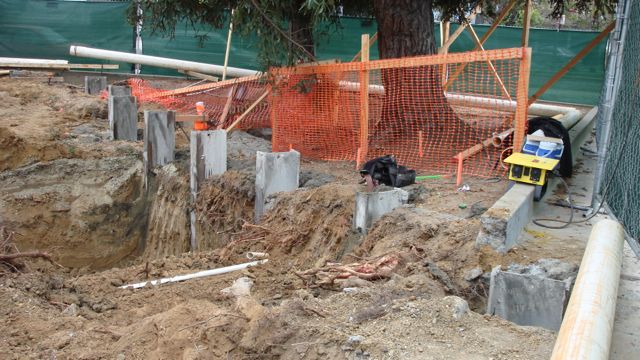
Roots found during construction
It’s also important to remember that roots can surprise you — direct inspection of the area is always required to be sure where roots are located. Estimating root spread based only on the canopy can be misleading. A tree’s dripline may be affected by pruning, site conditions, or competition from nearby trees, while the roots continue to occupy a much larger or differently shaped area underground.
For this reason, many arborists also consider trunk diameter when estimating root protection zones. A 2009 study by Susan Day and Eric Wiseman at Virginia Tech analyzed young trees less than eight inches in diameter growing in unobstructed soil and found a strong relationship between trunk diameter and root-system radius. This does not provide a universal formula for every tree, especially mature urban trees, but it does reinforce an important point: young trees may already have wider root systems than their canopies suggest.
Arborists often recommend a tree protection zone with a radius of one foot for every one inch of trunk diameter — a 12:1 ratio. It’s important to stress that this is only a guideline. The size and location of the zone varies by species, age, and condition of the tree, as well as by soil type and the nature of the surrounding environment.
For urban trees, this is where the question becomes especially important. A tree may be biologically capable of growing roots well beyond its canopy, but that does not mean the surrounding city soil will allow it. Pavement, compacted aggregate base, utilities, foundations, and fragmented planting areas can sharply limit where roots are able to grow. In these conditions, the root system may be smaller, more irregular, or concentrated only where water and oxygen are available.
This is why the question “how wide do tree roots grow?” is closely related to a better urban design question: how much usable soil are we giving them? When soil is compacted or available only in small volume quantities, the root system becomes constrained and irregular. When soil is connected, lightly compacted, and protected beneath hardscape, roots have a much better opportunity to spread into the space they need.
In the end, it’s crucial to retain a project arborist at the outset of any urban planning initiative to assist with tree and root assessment — and to recognize the environmental factors at play when planning underground space for root growth.
Original post by Leda Marritz and Ellyn Shea.
Sources:
Colorado State University Extension — “Understanding Tree Roots”
Iowa State University Extension — “Tree Anatomy 101”
Day & Wiseman / Virginia Tech — “At the Root of It” / Arboriculture & Urban Forestry
International Society of Arboriculture — “Getting to the Roots of the Matter”


Leave Your Comment