

A common assumption in urban tree design is that tree roots do not grow more than 24” below the surface. There’s a reason this idea has stuck around: in many city environments, roots are indeed concentrated close to the surface. Urban soils are often compacted, poorly drained, oxygen-limited, interrupted by utilities, or constrained by pavement and aggregate base. In those conditions, tree roots are forced into shallow, horizontal patterns.
But that does not mean trees are biologically limited to shallow rooting. Tree roots can grow much deeper than 24” when soil conditions allow it.
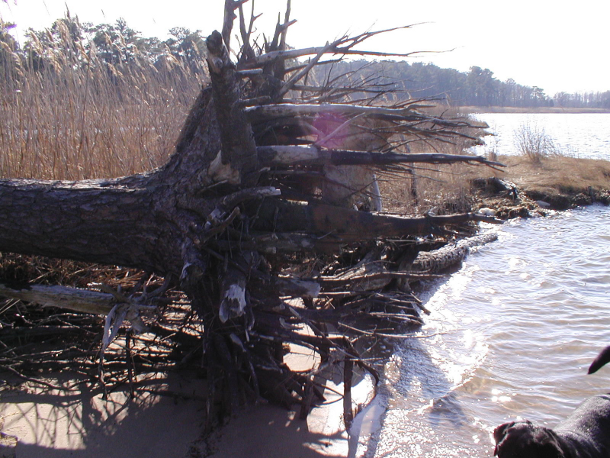
Six-foot-long sinker or striker roots in well-draining soils. Note the remnant of horizontal roots at the trunk flare. Photo courtesy of Miles Barnard.
How deep tree roots grow depends on three basic factors: water, oxygen, and soil that is loose enough to allow root penetration. If all three conditions are met, roots can grow to surprising depths. As Jim Urban, FASLA, puts it: “Trees are genetically capable of growing deep roots, but root architecture is strongly influenced by soil and climate conditions.”
That is the important distinction. Most urban tree roots may be functionally shallow, but they are not necessarily shallow by nature. Roots grow where they can find the right combination of moisture, air, nutrients, and penetrable soil. When those conditions exist deeper in the soil profile, roots can grow down. When they do not, roots stay closer to the surface.
Let’s examine some of the most common questions relating to tree root depth in urban environments.
| Common Question | Answer |
|---|---|
| Do tree roots only grow 24 inches deep? | No. Many roots are concentrated near the surface, but trees can grow deeper roots when soil oxygen, drainage, moisture, and pore space allow. |
| Why is 24 inches often treated as the urban tree depth standard? | Because many city trees grow in constrained conditions — compacted soil, poor drainage, pavement, aggregate base, utilities, and limited soil volume — that do not allow deeper root growth. |
| Where are most tree roots usually found? | In many landscapes, and especially in constrained urban soils, the active root zone is concentrated close to the surface. Iowa State University Extension notes that most tree roots are found in the top 18” of soil, with more than 50% in the top 6”. |
| How deep can roots grow in favorable conditions? | In favorable, oxygenated, well-drained soil, roots can commonly use the upper 3 feet of soil and may grow much deeper when conditions allow. Urban investigations in Stockholm found roots regularly at 7 to 9 feet deep, with one root observed at 23 feet. |
| What should cities focus on when creating tree rooting space? | Not a single maximum root depth, but the amount of connected, oxygenated, uncompacted soil volume available for roots to grow outward and downward. |
Source note: Iowa State University Extension notes that most tree roots are found in the top 18” of soil, with more than 50% in the top 6”. Colorado State University Extension notes that in favorable soil conditions, 90–95% of tree roots may be found in the top 36”, while compacted, clayey, or perpetually wet soils may restrict 90–95% of roots to the top 12” or less. The Stockholm root-depth observations come from Örjan Stål’s investigation of more than 500 trees with root and utility conflicts.
The truth lies somewhere between the old textbook image of a deeply rooted tree and the more recent urban forestry message that tree roots are almost entirely shallow and horizontal. Deep roots are possible. Shallow roots are common. The deciding factor is often not the tree alone, but the soil. In deep, oxygenated prairie soils, black walnut roots have been reported at 11-feet deep and white oak roots at 15-feet deep; in shallower forest soils, Florida dogwood, eastern red cedar, and sugar maple roots were found at roughly 1.5 to 3.5 feet. In Stockholm, researcher Örjan Stål regularly found roots at depths of 7 to 9 feet while investigating more than 500 trees with root and utility conflicts, with the deepest root observed at 23 feet.
Those examples are not meant to suggest that every city tree will — or should — root that deeply. They simply show that trees are not biologically limited to the top two feet of soil. While the active root zone is often concentrated near the surface, roots can grow much deeper when the soil profile provides oxygen, drainage, moisture, and pore space.
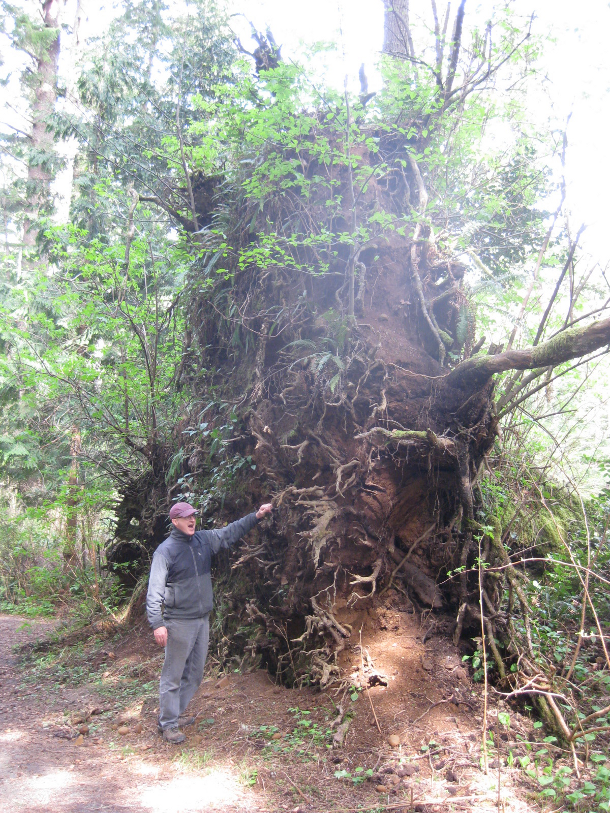
Four-foot-deep rooting in loam soil that was on top of a hard pan. Photo courtesy of James Urban.
This is where the design conversation becomes less about maximum root depth and more about soil volume. The real question for urban trees is not simply, “How deep can roots grow?” It is: “How much connected, oxygenated, uncompacted soil are we giving them?” Four feet of compacted, saturated fill is not the same as four feet of quality rootable soil. Roots are opportunistic; they will grow outward or downward where conditions are favorable.
In hardscape environments, Silva Cell helps apply this principle by creating a protected volume of lightly compacted soil beneath pavement. The structure supports pavement loads while the soil inside remains available for root growth, water movement, and oxygen exchange. The goal is not to force roots into one particular shape or depth, but to provide the conditions that allow roots to grow where they are able — outward, downward, or both. Tree roots can grow deeper than many people assume, but in cities they only do so when the soil profile allows it. The better urban forestry takeaway is simple: design the soil environment first.
Original post by Leda Marritz and Jim Urban.


Thanks for the interesting article. The photos included are somewhat misleading since what comes out of the ground in the situations shown are major roots. I’m guessing there are several more feet (and ultimately potentially hundreds or thousands of miles cumulatively) of small roots that get left in the ground. That would be a good follow up article – How many feet of roots cumulatively do trees have?
It’s true that many smaller, more delicate roots won’t make it out intact when a tree falls over. These photos are more useful as an illustration of how deep tree roots will grow under the proper conditions. I’m not sure how many cumulative feet of roots trees have; that’s a good question…
Interesting article: As a forestry student in the early 1960s we never delved that deeply into depth of roots (of course the pun is intended), but assumed they were “deep:”. As a Certified Arborist for the last 25 years I’ve been drilled into the “fact” that all root systems look like the typical “tip up” on a hard pan soil…about 2 feet deep at most…now in he last couple years we are all being retrained into howit “really is”….at last the truth shall make us free. Isn’t science andeducation wonderful!
Amazing how things change, it’s true. In the case of how deep tree roots grow, too many people are still stuck on the old “facts,” unfortunately…
Nice article. James Urban has definitely made his mark in the tree root world. Still, the article would have been greatly improved, and the photos infinitely more helpful if species names had been attached to the trees in the photos.
Question: I have a Norway Maple 80 years old and approx. 40 ft height, would anybody know how deep the roots would be for this tree. I am installing a new water line and it goes under the tree about 5ft down.
Thanks
Ya , but i think they may grow up 160 feet in search of water
Are olive trees typically deep rooted or not? A colleague here believes that olive trees are deep routed to allow them to grow in dry climates but my experience has been that they are shallow routed. What’s the experts opinion? Thanks.
My experience with olives is also that they tend to be shallow rooted, but I must admit to not being an expert on olives! I do know that roots will grow wherever they can find suitable conditions. So, while trees do tend to have certain rooting habits, you will see variation depending on the planting conditions. Sorry I can’t be more helpful!
Excellent post! Always happy to learn new things especially about trees. It’s amazing how roots can grow so deep. Thanks for sharing this!
Hi any one can answer, How deep the sandlewood root would be?
Im thanking to the authors of this article because it was very helpful to my research on roots and if i may i would like to copy some of the paragraphs of this article and i will assure you that your work will be acknowledge.
Different species have different root characteristics. I’ve dug out many. Yes olives are shallow rooted.