This video installation, “Years,” from artist Bartholomäus Traubeck, uses an optical… something… to “read” a thin cross section of a tree (the “record”) and translate it in to piano music. Continue reading

This video installation, “Years,” from artist Bartholomäus Traubeck, uses an optical… something… to “read” a thin cross section of a tree (the “record”) and translate it in to piano music. Continue reading

The specifications for most construction project are filled with seemingly endless phrases of precision such as “not less than 100 percent maximum density,” “no variation greater then ¼,” “shall be at least .005 in thickness,” “minimum strength of 3,000 psi,” etc. Why is this?
Buildings, bridges, roadways, utilities, and the like are all intended to last for 25 to 50 (or even 100) years. Engineers, architects and other design professionals know that phrases like the ones I’ve listed above and the standards that they are part of play a vital role in determining the life span of the finished product. Continue reading

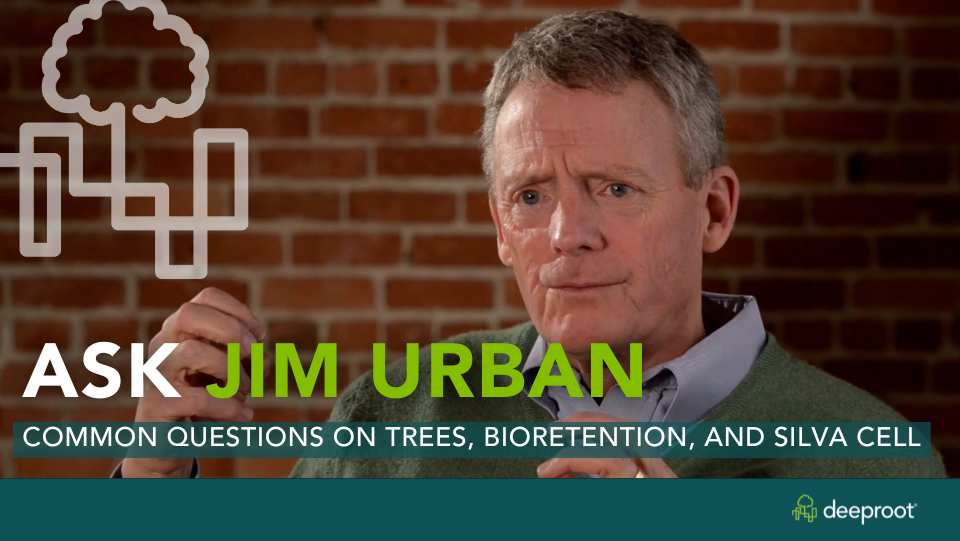
Last August I went to one of Jim Urban’s Up By Roots seminars in Davis, CA, and it was one of the best days I’ve spent learning more about trees, soil biology, and urban forestry. Jim is back on the road again this year, and on March 21st he’ll be presenting the Up By Roots seminar in Ft. Lauderdale. Continue reading

Meet Almond the cat, demonstrating both the independent feline spirit and the importance of tending to the trees and/or cats in front of your house. Continue reading
Through my work with DeepRoot, I’ve come to love and appreciate trees – especially urban trees – in a way that I never anticipated, so much so that I recently became a certified arborist. But my greatest love, since I was very little, was for animals. There is an intersection between these two interests, of course: wildlife.
While I spend most of my days at a desk, arborists who work out in the field have a big impact on wildlife, whether they’re aware of it or not. I like to think that people who care about trees probably care about other living things too, yet many arborists may not be aware of some of the basic steps they can take to avoid harming wild animals as they work. Continue reading

My favorite industry website recently is Linda Chalker-Scott’s Horticultural Myths. Dr. Chalker-Scott is an Extension Urban Horticulturist at the Puyallup Research and Extension Center at Washington State University, and she takes great delight in debunking common and inaccurate beliefs about best practices for trees and other plants. Her one-page myth busters are informative, easy to read, and very entertaining.

Finding influential tree people in any one industry or organisation can be difficult. Finding influential tree people in various disciplines to get around a table at the same time can be like trying to find the Loch Ness Monster or a Sasquatch: we hear about these rare things, but finding them is elusive.
Since its first publication in 2008, however, Trees and Design Action Group (TDAG) has indeed achieved the seemingly impossible. In their “No Trees, No Future” report, TDAG has representation from central and local governments, landscape architects, arboriculturalists, water companies, insurance companies, developers, universities and NGO lobbyists. In 2011, they followed up with another report, “The Canopy,” which is a compendium of solutions to issues that affect tree establishment in the urban realm. Continue reading

In the day-to-day, we can become so focused on what isn’t working with the way we design and plant street trees that it can be difficult to focus on the people and places that are actually doing right by them. It’s just so much easier than trying to move the needle.
To that end, I want to recognize the envelope-pushers — those municipalities that are rethinking the vital role trees play in the health of our planet and population and creating rules and recommendations to support them. They take action every day by promoting policies and projects that set trees up for long-term success and environmentally meaningful contribution.
We’ve identified the following communities for their ambitious policies that are redefining requirements for green utilities, specifically for trees, soil and stormwater management:

Earlier this year, Silva Cells were installed at the new Martin Luther King, Jr. memorial in Washington D.C. This site will commemorate the legacy of Dr. King but is not solely about the past; it is also about the future. Continue reading

2011 ended with a nice bit of publicity for the Silva Cell from The Globe and Mail (British Columbia edition only. Sad trombone). They filed it under the category “Things that work”!
Read the full article here.