
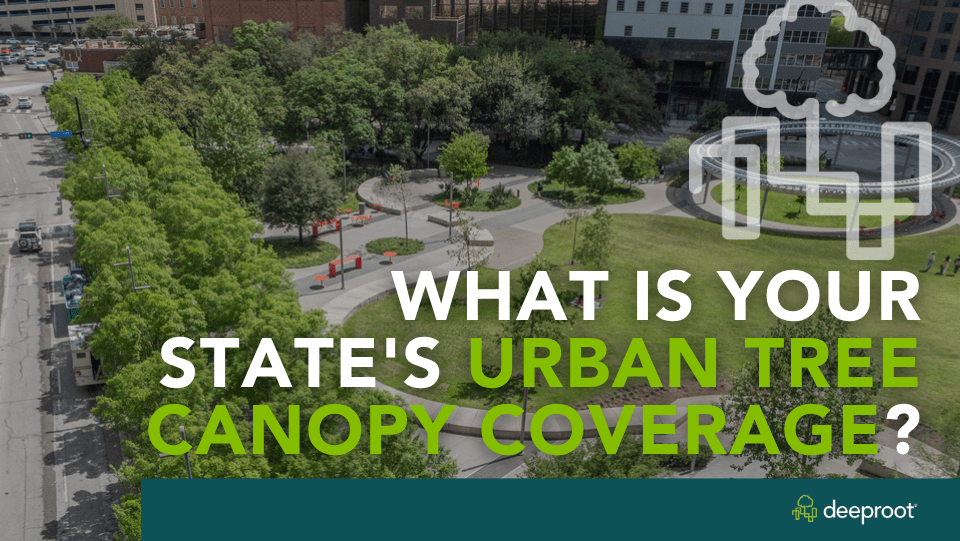
Urban tree canopy is the layer of leaves, branches and stems covering an urban area when viewed from above. Expressed as a percentage of land area, it provides a useful high-level picture of the extent of a community’s urban forest.
Below is the most current comprehensive 50-state canopy summary we could identify. The analysis was created by PlanIT Geo and EarthDefine for use by the Arbor Day Foundation and U.S. Forest Service. It uses high-resolution aerial imagery from the USDA’s National Agriculture Imagery Program, primarily collected between 2021 and 2023. The percentages apply only to land within 2023 Census-defined Urban Areas, not each state’s total geographic area.
State Canopy Coverage
Alabama 44.7%
Alaska 37.8%
Arizona 10.7%
Arkansas 37.8%
California 14.3%
Colorado 15.0%
Connecticut 51.6%
Delaware 32.9%
Florida 36.7%
Georgia 51.3%
Hawaii 27.3%
Idaho 14.0%
Illinois 26.9%
Indiana 26.0%
Iowa 21.4%
Kansas 25.4%
Kentucky 31.0%
Louisiana 32.8%
Maine 52.1%
Maryland 45.7%
Massachusetts 51.9%
Michigan 34.8%
Minnesota 29.6%
Mississippi 42.8%
Missouri 33.9%
Montana 11.4%
Nebraska 16.1%
Nevada 7.2%
New Hampshire 56.1%
New Jersey 42.6%
New Mexico 9.8%
New York 41.2%
North Carolina 48.3%
North Dakota 9.9%
Ohio 32.5%
Oklahoma 21.9%
Oregon 24.6%
Pennsylvania 38.7%
Rhode Island 44.9%
South Carolina 47.2%
South Dakota 13.8%
Tennessee 38.2%
Texas 24.4%
Utah 10.3%
Vermont 44.8%
Virginia 43.0%
Washington 32.6%
West Virginia 45.8%
Wisconsin 27.8%
Wyoming 7.6%
Understanding the Numbers
Urban canopy coverage varies considerably across the country — from approximately 7% in Nevada to more than 56% in New Hampshire. Climate, natural vegetation, development density, land use, water availability and local planting practices all affect these numbers.
The table should therefore not be treated as a simple ranking. There is no single canopy target appropriate for every state or city. Communities should establish goals based on local conditions while also considering where canopy is distributed and which neighborhoods need additional shade and cooling most.
Statewide percentages also do not describe tree condition, species diversity, age or long-term resilience. Ultimately, healthy canopy depends on protecting existing trees and providing newly planted trees with sufficient soil, water and rooting space to reach maturity.
Sources