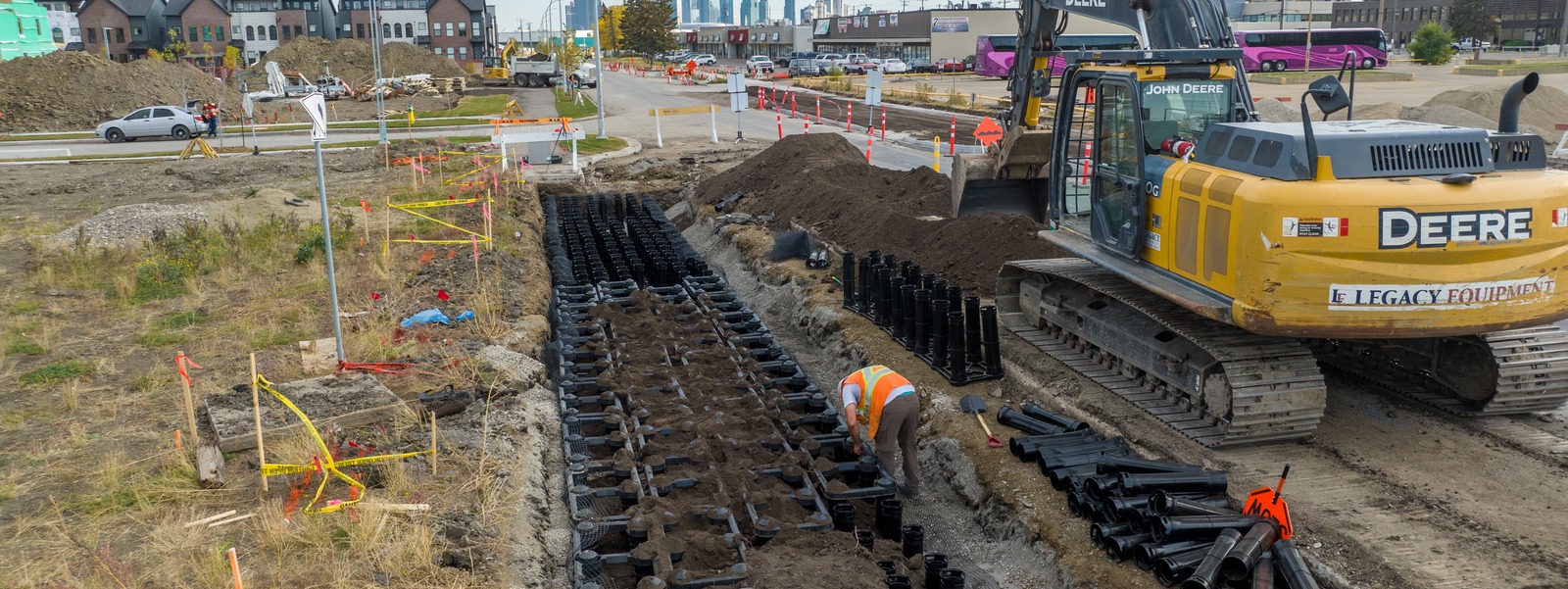
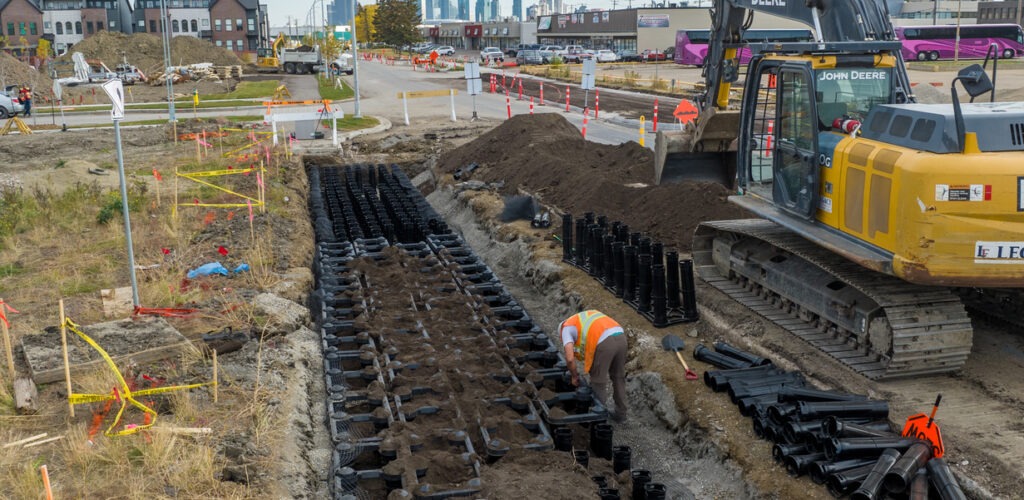
One of the biggest factors in the success or failure of an urban tree is whether it has access to enough soil. This is why regional soil volume standards for new street tree plantings are so important: they turn good intentions into clear policy, giving planners, designers, and developers a defined baseline for supporting long-term tree health. Cities that adopt these standards are making a meaningful investment in healthier canopies, stronger urban forests, and the many public benefits mature trees provide, from shade and cooling to stormwater management and improved quality of life.
At DeepRoot, we believe every municipality should establish soil volume standards, because this is one of the most important policy steps a city can take to set its trees up for long-term success. The cities in the table below have adopted standards that are already helping support healthier urban forests.
| City | Country | Soil volume (ft3) | Soil volume (m3) | Required/Recommended | Notes |
|---|---|---|---|---|---|
| Alexandria, VA | USA | 450 | 12.7 | REQUIRED | |
| Aspen, CO | USA | 240/600/1200 | 6.8/17.0/34.0 | REQUIRED | Tiered requirement for small, medium, and large trees. |
| Athens-Clarke County, GA | USA | 200/450/800 | 5.7/12.7/22.7 | RECOMMENDED | Tiered recommended values for small, medium, and large trees. |
| Austin, TX | USA | 1000 | 28.3 | REQUIRED | PUD ordinance condition. Allows up to 25% shared soil among adjacent trees; City Arborist may reduce the minimum if conflicts exist. |
| Bellevue, WA | USA | 500/1000/1500 | 14.2/28.3/42.5 | REQUIRED | Tiered requirement for small, medium, and large trees. |
| Boise, ID | USA | 500 | 14.2 | REQUIRED | |
| Buckinghamshire, UK | UK | 21.2 per m2 crown area | 0.6 per m2 crown area | RECOMMENDED | Formula-based standard rather than a fixed per-tree minimum. Based on 0.6 m3 per 1 m2 of projected mature crown area, converted here to 21.2 ft3 per 1 m2. |
| Calgary, AB | Canada | 706.3/1059.4 | 20.0/30.0 | REQUIRED | Draft street-manual cross-sections for large-canopy public trees. 20 m3 applies as a local-streets allowance; 30 m3 applies as the larger public-tree requirement. |
| Charlotte, NC | USA | 600/822 | 17.0/23.3 | REQUIRED | Two context-specific values: about 600 ft3 for parking-lot trees and about 822 ft3 for sidewalk-tree areas, both based on area and assumed depth. |
| Chicago, IL | USA | 72 per ft2 surface area | 2.0 per ft2 surface area | REQUIRED | Area- and depth-based standard rather than a simple per-tree tier. The ordinance is expressed as 3 ft of soil depth with 24 ft2 of surface area, implying 72 ft3. |
| Cleveland, OH | USA | 300/600/1000 | 8.5/17.0/28.3 | RECOMMENDED | Tiered recommended values for small, medium, and large trees. |
| Columbus, OH | USA | 750/1000 | 21.2/28.3 | REQUIRED | Downtown streetscape standard with 1000 ft3 for single-tree conditions and 750 ft3 where soil is shared. |
| Decatur, GA | USA | 108/300/675/1200 | 3.1/8.5/19.1/34.0 | REQUIRED | Tiered requirement covering very small, small, medium, and large trees. |
| Denver, CO | USA | 900/1000 | 25.5/28.3 | REQUIRED | Rule states a minimum irrigated soil-volume range of 900–1000 ft3 per tree. |
| Detroit, MI | USA | 600/1000/1500 | 17.0/28.3/42.5 | RECOMMENDED | Soil volumes for small, medium, and large trees based on mature height class. |
| Durham, NC | USA | 450/750/1050 | 12.7/21.2/29.7 | REQUIRED | Small, medium, and large trees. |
| Edmonton, AB | Canada | 600 | 17 | REQUIRED | |
| Emeryville, CA | USA | 600/900/1200 | 17.0/25.5/34.0 | REQUIRED | Tiered requirement for small, medium, and large trees. |
| Fairfax County, VA | USA | 700/1200 | 19.8/34.0 | REQUIRED | 700 ft3 for single-tree conditions and 1200 ft3 for double-tree conditions. |
| Fairfax, VA | USA | 400/500/600/700/800/1000 | 11.3/14.2/17.0/19.8/22.7/28.3 | REQUIRED | Table-based minimums by plant category and soil-sharing condition. Category I: 500 single / 400 shared. Category III: 700 single / 600 shared. Category IV: 1000 single / 800 shared. Maximum counted depth is 3 ft. |
| Guelph, ON | Canada | 635.7/1271.3/1765.7 | 18.0/36.0/50.0 | RECOMMENDED | 18 m3 for small trees, 36 m3 for medium trees, and 50 m3 for large trees. |
| Kalamazoo, MI | USA | 300/600/1000 | 8.5/17.0/28.3 | RECOMMENDED | Minimum recommended soil volumes for small, medium, and large trees. Guidance says soil volume should be as large as possible. |
| Kelowna, BC | Canada | 141.3/706.3 | 4.0/20.0 | REQUIRED | 4 m3 minimum allowable soil volume per tree in constrained contexts; 20 m3 minimum available root zone for wide boulevard or wide median trees. |
| Kitchener, ON | Canada | 388.5/600.4/653.3/988.8/1059.4/1589.2 | 11.0/17.0/18.5/28.0/30.0/45.0 | REQUIRED | Shared and single-tree volumes vary by size class. Small: 11 m3 shared / 17 m3 single. Medium: 18.5 m3 shared / 28 m3 single. Large: 30 m3 shared / 45 m3 single. |
| Leeds, UK | UK | 176.6/423.8/1059.4 | 5.0/12.0/30.0 | RECOMMENDED | Target volumes for small, medium, and large canopy classes. Guidance explicitly ties sizing to crown-area calculations using 0.6 m3 soil per 1 m2 of crown area. |
| Markham, ON | Canada | 529.7/1059.4 | 15.0/30.0 | REQUIRED | 15 m3 minimum for parking-lot island planting and 30 m3 for large-stature trees. Large-tree requirement also notes a depth of 90–120 cm. |
| Minneapolis, MN | USA | 500 | 14.2 | REQUIRED | Engineered root-space detail: minimum 500 ft3 soil volume per tree, cited via a plan/standard-plate reference. |
| Minnesota, MN | USA | 400/800/1200 | 11.3/22.7/34.0 | RECOMMENDED | State-level guidance listed with small, medium, and large tree targets. |
| Montréal, QC | Canada | 370.8/529.7 | 10.5/15.0 | REQUIRED | 10.5 m3 for continuous planting pits serving 2 or more trees and 15 m3 for an individual planting pit. |
| New York City, NY | USA | 200 | 5.7 | REQUIRED | Zoning requirement for public-plaza trees. Also requires a minimum soil depth of 3 ft 6 in, so this is not a general citywide street-tree standard. |
| Nottinghamshire, UK | UK | 176.6 | 5.0 | REQUIRED | Minimum 5 m3 soil volume, stated as suitable for trees with canopy diameter up to about 3.0 m. |
| Oakville, ON | Canada | 529.7/1059.4 | 15.0/30.0 | RECOMMENDED | 15 m3 in shared-soil situations and 30 m3 for single-tree conditions. |
| Ottawa, ON | Canada | 882.9/1059.4 | 25.0/30.0 | REQUIRED | Sensitive marine clay soils guidance. 25 m3 applies to small trees and 30 m3 applies to medium trees. |
| Palo Alto, CA | USA | 400/800/1200 | 11.3/22.7/34.0 | REQUIRED | Tiered minimum required soil volumes based on canopy diameter class: under 25 ft, 25–35 ft, and over 35 ft. |
| Pompano Beach, FL | USA | 450/820/1280 | 12.7/23.2/36.2 | REQUIRED | Tiered requirement for small, medium, and large trees. |
| Raleigh, NC | USA | 600 | 17.0 | REQUIRED | |
| San Diego, CA | USA | 600/1000/1500 | 17.0/28.3/42.5 | REQUIRED | Tiered requirement for small, medium, and large trees. |
| Seattle, WA | USA | 600/1000/1200/1500 | 17.0/28.3/34.0/42.5 | REQUIRED + RECOMMENDED | Mixed system. 1200 ft3 is a required ROW and downtown design standard in certain contexts. The city also provides recommended size-based guidance of 600 small, 1000 medium, and 1500 large. Notes say structural soil may need roughly 4x–5x the volume to match soil-cell performance. |
| Sheffield, UK | UK | 176.6/706.3 | 5.0/20.0 | RECOMMENDED | 5 m3 minimum where possible for highway tree planting; the guidance also cites about 20 m3 as an expected volume in paved situations. |
| Surrey, BC | Canada | 353.1/529.7/706.3/1059.4 | 10.0/15.0/20.0/30.0 | RECOMMENDED | Recommended size-based system with lower shared-soil volumes. Small: 15 m3 single / 10 m3 shared. Medium: 20 m3 single / 15 m3 shared. Large: 30 m3 single / 20 m3 shared. |
| Syracuse, NY | USA | 540/800 | 15.3/22.7 | REQUIRED | 540 ft3 minimum per tree for a typical tree pit. The guidance also gives an 800 ft3 continuous-rooting-volume example for two adjacent trees in shared soil. |
| Tacoma, WA | USA | 72/120/180 | 2.0/3.4/5.1 | REQUIRED | Tiered requirement for small, medium, and large trees. |
| Tigard, OR | USA | 400/1000 | 11.3/28.3 | REQUIRED | Requirement range of 400–1000 ft3. |
| Toronto, ON | Canada | 706.3/1059.4 | 20.0/30.0 | REQUIRED | 30 m3 baseline minimum per tree planting area, with 20 m3 allowed where soil is shared among trees. The standard also includes a site-wide calculation basis. |
| Vancouver, BC | Canada | 882 | 25 | REQUIRED | Park development standard drawing requires a minimum of 20 m3 total soil volume per tree and notes a minimum depth of 900 mm. |
| Victoria, BC | Canada | 211.9/282.5/529.7/706.3/1059.4/1236.0 | 6.0/8.0/15.0/20.0/30.0/35.0 | REQUIRED | Bylaw schedule with minimum and shared/irrigated targets by tree size. Small: 8 m3 minimum / 6 m3 shared. Medium: 20 m3 minimum / 15 m3 shared. Large: 35 m3 minimum / 30 m3 shared. Also includes soil-volume equivalency factors such as soil cells x0.92 and structural soil x0.2. |
| Washington, DC | USA | 600/800/1000/1500 | 17.0/22.7/28.3/42.5 | REQUIRED + RECOMMENDED | Mixed system. Required public-space minimums are 600 small, 1000 medium, and 1500 large. Separate streetscape guidance recommends 800 small, 1000 medium, and 1500 large. |
| West Virginia, WV | USA | 500/750/970 | 14.2/21.2/27.5 | REQUIRED | Tiered values for small, medium, and large trees. |
| Winnipeg, MB | Canada | 211.9/282.5/529.7/706.3/1059.4/1236.0 | 6.0/8.0/15.0/20.0/30.0/35.0 | REQUIRED | Size-based system with different individual and shared-soil volumes. Small: 8 m3 single / 6 m3 shared. Medium: 20 m3 single / 15 m3 shared. Large: 35 m3 single / 30 m3 shared. Planting soil depth of 900 mm is also noted. |
| Halifax, NS | Canada | 812 | 23 | REQUIRED | Can be 11 m3 in a shared space |
| North Vancouver, BC | Canada | 882 | 25 | REQUIRED | |
| York, ON | Canada | 1060 | 30 | REQUIRED |
 Soil. Stormwater. Sustainable Infrastructure.

Request a Quote [email protected]
Tel: 415 781 9700
Toll Free: 800 458 7668
Toll Free: 800 277 7668
Fax: 415 781 0191
