

Download our research overview document here.
Today, the idea that urban trees need real soil volume to reach maturity is no longer controversial — it’s widely accepted among urban foresters and landscape architects. We also recognize that providing that soil volume, especially with systems like Silva Cells, represents a meaningful upfront investment. But decades of installations and research now show that this investment is intentional and strategic: when trees have access to large volumes of uncompacted soil, they grow larger, live longer, and deliver far greater environmental and economic value. Silva Cells were designed around this principle, and thousands of projects have proven it in practice. The question has shifted from “Do soil-volume strategies like Silva Cells grow large trees?” — because we now know they do — to “How do these trees return value on the initial investment?”
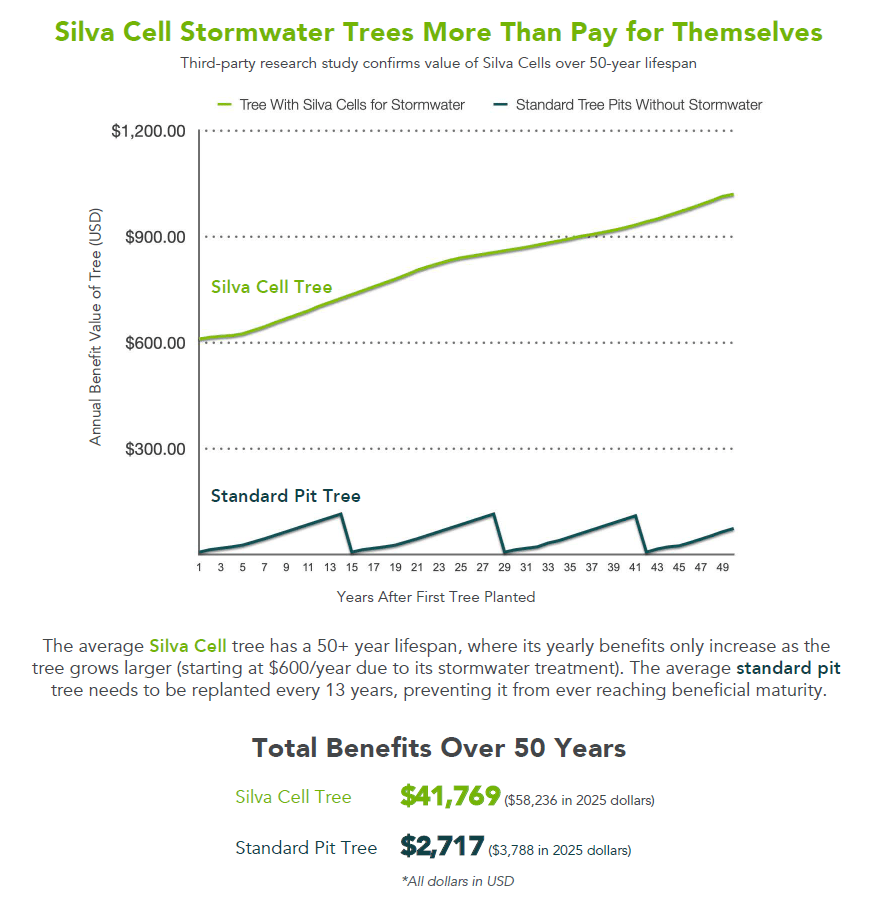
A third-party lifecycle cost analysis prepared by The Kestrel Design Group examined what happens when a city invests in adequate soil volume versus planting trees in conventional small pits. The study compared a tree planted with 1,000 cubic feet of soil supported by Silva Cells to a typical 4’×4’×4’ tree pit surrounded by pavement. Using the USDA Forest Service’s peer-reviewed i-Tree software, the researchers evaluated costs and benefits over a 50-year period, including energy savings, stormwater interception, carbon sequestration, and property value impacts.
The contrast was stark: while the Silva Cell tree was modeled to live 50+ years, the typical pit tree was expected to survive only about 13 years before needing replacement.
Because small-pit trees rarely reach maturity, their benefits plateau early and then reset each time the tree is replaced. On the other hand, the Silva Cell tree (modeled with stormwater management properties in the study) continues growing and delivering greater value year after year. Over 50 years, the study found total estimated benefits of $41,769 for the Silva Cell tree compared to just $2,717 for the standard pit tree. Even accounting for higher upfront installation costs, the Silva Cell scenario produced net lifecycle benefits exceeding $25,000, while the conventional pit scenario resulted in a net lifecycle cost.
In other words, the question isn’t whether large, healthy trees provide value — it’s whether cities can afford not to help trees reach maturity.
Recently, we revisited this research and updated the figures to reflect today’s dollars and current messaging. The conclusions still hold: Silva Cell trees more than pay for themselves over their lifetime, with total 50-year benefits equivalent to over $58,000 in today’s dollars. Meanwhile, the typical pit tree remains trapped in a cycle of short lifespans and limited returns. The takeaway is straightforward: when cities design for mature trees from day one, they unlock decades of compounding environmental, social, and economic benefits. Healthy urban trees aren’t a luxury — they’re long-term infrastructure that appreciates over time.

Leave Your Comment